
Packing decisions
How to estimate the packing supplies your household needs
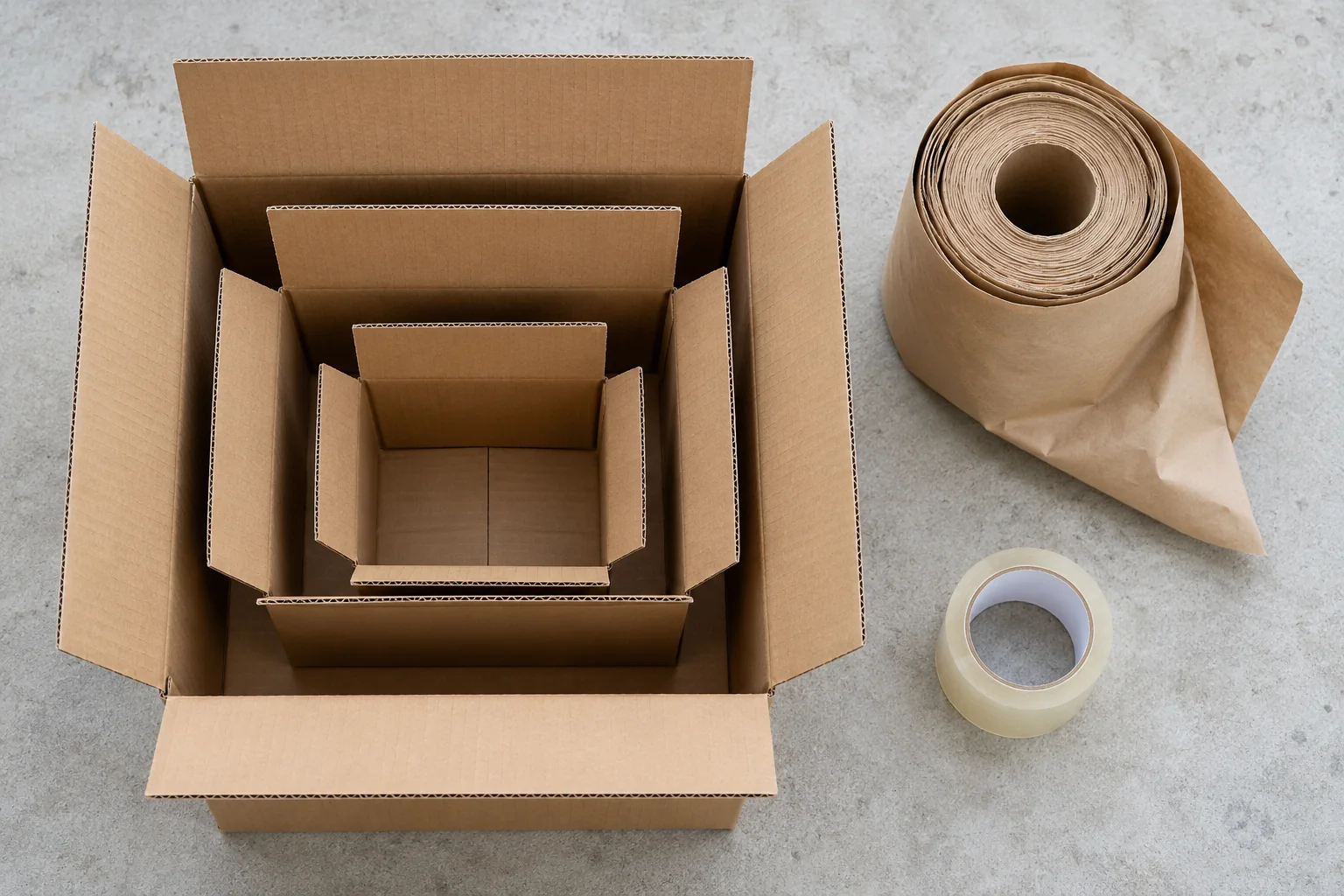
A packing supply estimate should start with the belongings you will actually move. Room count is a rough description of a home, not a count of objects that need cartons or protection. Two households in equally sized apartments can have very different collections of books, dishes, clothing and furniture. Use an inventory by group, decide how each group will travel and then count the materials required by that plan.
You do not need a precise forecast before the first purchase. You need transparent assumptions and a way to update them after packing a small sample. Start with what you can see, make an initial list, test it on one shelf or category and revise. Keep any remaining uncertainty visible so a shopping list does not appear more exact than the information behind it.
Decide who supplies materials under the transport arrangement. A mover may provide some items as part of a service, offer them separately or expect the household to prepare everything. Read the written scope. The household's estimate should cover only what it needs to obtain, while still recording materials that someone else has promised to supply.
Inventory the work before the products
Walk through every room and storage space. List groups that will need packing: books, kitchenware, small electronics, clothing, linens, documents and other belongings relevant to the household. Include garage, attic or external storage items that will travel. Do not count furniture that will move as a unit as though it needs a standard carton.
Mark items that will not go. Donations, sales, returns and leave-behind belongings should not inflate the supply order. If a decision is still open, label it uncertain. A carton estimate built from objects you might later remove can be corrected, but the correction is easier when the original assumption is visible.
For each group, ask how it will travel. Some clothing may remain on hangers under the chosen service, go into a garment bag or be folded into cartons. Some documents may stay with the household. A collection of framed pieces may need protection other than an ordinary box. Choose the method before counting the material.
Write the chosen method beside the inventory group. Avoid a single total labeled packing supplies until the components have a purpose. A count of cartons becomes useful when you know which belongings each carton is expected to hold and which groups require different handling.
Use a small packing trial
Pick a representative shelf, drawer or category and pack it with the materials you plan to use. Record the number and size of cartons, the amount of wrapping material and the time required. Note any difficulty, such as a carton that became too heavy before it was full or an item that did not fit the expected shape.
Do not multiply the result blindly across every room. A shelf of books does not predict the supplies for bedding or cookware. Use the trial for groups that resemble it, then run another trial for a different category. The goal is to replace vague guesses with observations from the actual household.
For example, if one short shelf of books fills two small cartons while keeping them manageable, inspect the remaining book shelves and estimate how many similar sections they contain. If another shelf holds oversized albums, treat it separately. The resulting count is an assumption you can explain and revise, not a national average.
Keep the trial cartons labeled and included in the inventory. They are part of the move, not a separate experiment. If you reopen them to adjust the packing method, update the count. A sample is most valuable when it also makes progress on the job.
Match carton size to contents
A carton should be suitable for the contents and manageable under the handling method you will use. Dense books, dishes, soft linens and bulky light objects place different demands on shape and strength. Use the relevant product instructions and provider requirements. Do not select every carton by the amount of empty shelf space it appears to hold.
Estimate by category. Books may call for smaller cartons because they become heavy. Bulky, light bedding may need larger containers. Fragile items may require space for appropriate protection. These are planning distinctions, not a claim that one size is mandatory for every object. Test a few before ordering a large quantity.
Consider what you already own. Reusable bins, suitcases and sound cartons may handle some belongings if they meet the transport provider's requirements. Inspect their condition. A container that is cracked, damp or difficult to close should not be counted as usable merely because it is available.
Avoid making a single oversized carton carry unrelated heavy and fragile items. That choice can complicate handling and labeling. Group contents by destination and handling needs when practical. A clear set of groups makes it easier to estimate both the number of containers and the work needed to unpack them.
Count protection by item, not by room
List items that need wrapping or separation, such as breakable kitchenware, framed objects and vulnerable surfaces. Decide what type of protection suits each item and the transport arrangement. Use product guidance and the provider's instructions for specialized belongings. A generic roll of material does not solve every protection question.
Estimate how many pieces can be covered with the materials you intend to buy. A trial can show whether your first assumption is realistic. Record material used for the sample and scale only to similar items. Do not use a plate as the model for a lamp or a large framed print.
Distinguish cushioning from filling empty space. If a carton has excessive space after the contents are arranged, you may need a different carton size or suitable fill. Do not buy material in a large quantity before seeing whether the chosen carton method creates that need. Better carton selection can reduce the amount of extra material required.
Ask whether furniture coverings or protective materials are included in the mover's service. If they are, record which items and stages that promise covers. If you are moving yourself, identify what protection the actual route and vehicle require. Keep this separate from the cartons used for small belongings.
Plan tape, labels and markers from the carton count
Once you have a preliminary carton count, estimate the closures and labels needed for that count. Check the instructions for the tape and cartons you use. Do not assume every container requires the same amount, especially if some are reusable bins with their own lids.
Allow enough labels to show destination and useful contents. The guide to a room-by-room labeling system for moving boxes explains how to keep labels consistent. Your supply list might include plain labels or suitable markers, but the exact product matters less than whether the writing remains legible and the system can be used by everyone packing.
Keep markers and tape accessible during the entire packing period. One shared marker can disappear when two people pack in different rooms. A small extra set of ordinary tools may be practical, but record the actual team and schedule rather than buying duplicates without a reason.
If you plan to use a digital inventory, test how it connects to physical cartons. A number in a phone is only useful when the carton has a matching visible identifier. Count any labels or tags required by that method. Avoid purchasing specialized supplies for a system no one in the household will maintain.
Separate special items from the general count
Home office equipment may need a more deliberate method. Keep related cables and accessories identified, and check provider instructions for screens or other equipment. The guide to planning the move of a home office can help assign what stays available for work and what materials must protect the rest.
Framed art, mirrors, instruments and other unusual shapes may not fit the cartons you use for books or kitchenware. List them individually and ask the relevant provider about preparation. Do not assume a product advertised for an item is suitable for every size or condition. Obtain dimensions and the actual handling plan first.
Personal records and essential medication may stay with the household. Their containers and travel bags should be counted separately from the moving shipment. This prevents a supply estimate from treating irreplaceable or immediate-use belongings as ordinary packed cartons.
If a large item will be donated or sold before loading, set a decision date. Keep its materials out of the confirmed purchase until the outcome is known. If the item remains, revise the list and obtain what it needs. The ability to change a plan is more valuable than buying a specialty product for an item that may never move.
Build a purchase list with assumptions visible
Create a line for each material with quantity, purpose, source and status. A status might be already owned, supplied by provider, priced for purchase or still unknown. A blank quantity should not mean zero. It should prompt a decision or trial. This is a household planning record, not an invoice.
Add the groups that support each quantity. For example, the carton line can identify books, kitchen and linens separately. If you later decide to leave most books, you can see which part of the count to revise. A single total without its components is harder to correct.
Distinguish a confirmed price from a household allowance. A supplier's current price for a selected product is one kind of number. An amount you set aside because you have not chosen the product is another. Keep them labeled. This makes the shopping list useful when the actual supplier or carton size changes.
Include return or reuse plans if they affect the purchase. Some materials can be borrowed, reused or returned under the supplier's stated terms. Confirm those terms before treating an expected return as a saving. A product that must remain clean and unused to be returned should not be counted as available for packing and as a guaranteed refund at the same time.
Check the timing of supply deliveries
Buy or collect enough for the first packing sessions, then review the count. Do not wait until the final day to discover that the chosen carton size is unavailable. The purchase schedule should match the packing sequence and the space available to store materials.
If you order supplies for delivery, record the promised arrival and the session that depends on them. A late order can hold up packing even when the budget is sufficient. Consider an alternate source for a small remaining quantity, without assuming its products will be identical. Check that any substitute meets the practical requirements.
Keep new supplies dry and accessible. A large order stored in a damp garage or behind furniture may be unusable when needed. Make room for it before it arrives. The household needs a supply zone as much as it needs a stack of products.
If a mover will provide materials on packing day, confirm the arrangement and what preparation the household must complete first. Do not assume the company's supply promise covers items you will pack yourself during the preceding weeks. Clarify the boundary between services.
Update the estimate as packing reveals the shipment
After each completed category, compare the actual carton count with the working estimate. If it differs, identify why. Perhaps the shelves held more books than expected, the carton size changed or an item group will no longer travel. Update the relevant line instead of adding a vague miscellaneous quantity.
Watch for overpacking and underpacking. A carton that cannot be handled as planned may need to be repacked into smaller units. A large carton with too much empty space may use more protection material than expected. The supply estimate should respond to what the household learns, not force every item into the first plan.
Tell the transport provider when the number or type of packed items differs materially from the inventory used for its estimate. Ask whether the shipment description needs revision. Your materials worksheet does not itself change a transport agreement. Keep the communication and revised document with the moving file.
Stop buying when the remaining work is small enough to count directly. At that point, list the actual unpacked groups and obtain only what they require. A percentage buffer that made sense early in planning may be unnecessary once most belongings are packed.
Count what the first night requires
The supplies needed for the first night at the destination have a different job from those used for general storage. Decide which bedding, basic kitchen items, toiletries and chargers will travel with people and which will be in marked cartons. That decision may call for a durable travel bag or small container, but it should not be hidden in the standard carton count. The household needs to be able to find these items even if unloading takes longer than expected. Tell the person in charge of loading which container stays with the travelers, and check that it is never placed among general shipment cartons.
Check whether the first-night container will be carried in a personal vehicle, a rental vehicle or the main shipment. Its size and contents should fit that route. If several people travel separately, assign the relevant essentials to each person rather than assuming one bag will be available to everyone. Count any extra containers only after the travel plan is clear.
Consider unpacking as part of the supply plan. You may need a safe place for empty cartons and used packing material while the home is still being arranged. Ask the building how material should be handled if it has specific rules. Do not buy a disposal product based on an assumed rule. The supplier's return terms and local handling options may affect what you choose, but confirm them before the move.
Keep a small reserve of labels and closure materials accessible after arrival. An opened carton may need to be closed again if furniture placement changes or a storage period is added. This is a practical reason for a modest leftover supply, distinct from buying an arbitrary percentage of extra cartons. Use the final inventory to decide what remains necessary.
Use a hypothetical calculation without turning it into an average
Suppose a household observes that two similar shelves of books fill four small cartons. It has three more shelves of comparable books. A first planning estimate for those remaining shelves is six cartons, giving ten for all five shelves. This is a hypothetical method for one household. It is not a recommended number of cartons for five shelves in every home.
Now suppose one of the remaining shelves contains large albums that do not fit those cartons. Move that shelf out of the comparable group and test it separately. The original estimate becomes eight small cartons for four comparable shelves, plus whatever method suits the albums. The revision improves the estimate because it reflects a real difference in the contents.
The same logic can be used for linens or kitchenware, with a different sample and suitable containers. Do not combine the results into one blanket cartons-per-room formula. A transparent estimate lets you explain what has been counted, what remains uncertain and when the next update is due.
Keep the final shopping list tied to the packing method the household will use. If a provider changes the service scope or the shipment shrinks, revise the list before buying the last materials. The useful outcome is enough appropriate supplies to finish the move without filling the home with unused products.